Photo Restoration vs. Photo Retouching: What’s the Difference?
BLOG
What’s the Difference?
Photo restoration repairs damage and deterioration in old photographs, while photo retouching typically improves the appearance of an image by adjusting details such as color, skin, lighting, or distracting elements. If you have a faded, torn, scratched, stained, or damaged family photograph, photo restoration is usually the appropriate service. Retouching is more commonly used when the photograph is intact but needs visual improvements.
Understanding this distinction can help you choose the right service and avoid unnecessary changes to an irreplaceable photograph.
At Feldman’s Photography, we specialize in restoring, scanning, color correcting, and digitizing photographs so families can preserve important images for future generations.
What Is Photo Restoration?
Photo restoration is the process of repairing and improving an old or damaged photograph, usually after creating a high-resolution digital copy of the original.
The purpose is not simply to make the photograph more attractive. Restoration focuses on correcting damage caused by age, storage conditions, accidents, fading, moisture, handling, and other factors.
Professional photo restoration may address:
- Fading
- Tears
- Cracks and creases
- Scratches
- Stains
- Water damage
- Discoloration
- Missing portions
- Dust and blemishes
- Poor contrast
- Color shifts
- Other signs of deterioration
For example, imagine an old wedding photograph from several decades ago. The image has developed a yellow tint, a crease runs through one person's face, and several areas have faded.
That photograph needs more than basic editing. A restoration specialist can create a high-resolution digital copy and carefully repair the damaged areas while maintaining the overall character of the original image.
You can see examples of this type of work on the [Photo Restoration & Repairs – https://www.feldmansphotography.com/photo-restoration---repairs] page.
What Is Photo Retouching?
Photo retouching is generally used to improve the appearance of an image that does not necessarily have significant age-related damage.
Retouching can include:
- Adjusting brightness
- Improving contrast
- Correcting colors
- Removing minor distractions
- Reducing blemishes
- Cleaning up backgrounds
- Cropping an image
- Enhancing certain details
- Making selective visual improvements
A newer family portrait, for example, might be perfectly intact but have an unwanted object in the background. Retouching could be used to remove that distraction.
The key difference is the purpose.
Restoration attempts to repair what time or damage has taken away. Retouching adjusts or enhances what is already there.
Sometimes an old photograph needs both.
Photo Restoration vs. Photo Retouching at a Glance
| Photo Restoration | Photo Retouching |
|---|---|
| Repairs old or damaged photographs | Improves an existing photograph |
| Corrects fading and deterioration | Adjusts appearance |
| Repairs tears, cracks, and scratches | Removes minor distractions |
| May reconstruct missing areas | May enhance existing details |
| Often used for family and historical photographs | Commonly used for portraits and newer images |
| Focuses heavily on preservation | Focuses primarily on presentation |
| Usually begins with high-resolution digitization | Usually starts with an existing digital image |
The distinction matters because an irreplaceable historical or family photograph often requires a more careful approach than a routine digital image.
How Do I Know Whether My Photo Needs Restoration?
A simple question can help:
Has the photograph physically or visually deteriorated since it was originally created?
If the answer is yes, restoration is probably what you need.
Signs that an old photograph may need restoration include visible cracks, faded colors, scratches, torn edges, water stains, discoloration, missing pieces, or areas where details have become difficult to see.
You might also notice that an old color photograph has developed an unnatural red, orange, yellow, or blue cast.
These aren't simply aesthetic preferences. They are changes that have occurred to the photograph over time.
Professional restoration aims to correct those problems while respecting the original image.
When Is Photo Retouching the Better Choice?
Retouching may be appropriate when the photograph is already in relatively good condition but you want to improve specific visual details.
For example, you may want to:
- Remove an unwanted object from the background.
- Improve overall brightness.
- Correct minor color problems.
- Clean up small distractions.
- Make an image more suitable for enlargement.
- Create a polished version for display.
Retouching doesn't necessarily mean dramatically changing the person or scene.
For important family photographs, subtle adjustments are often more appropriate than aggressive editing. The finished image should still feel connected to the original memory.
Can an Old Photograph Need Both Restoration and Retouching?
Yes. In fact, the line between restoration and retouching can overlap.
Suppose you have a 60-year-old family portrait. It has a large scratch, faded colors, and a distracting background element.
The scratch and fading would fall under restoration because they represent damage or deterioration.
Removing the distracting background element would be closer to retouching because it changes an existing part of the image for aesthetic reasons.
A professional can evaluate the photograph and determine which combination of repairs and adjustments will produce the best result.
Why Is High-Quality Scanning Important Before Restoration?
The quality of the digital copy can influence the restoration process.
If an old photograph is captured poorly, important details may be lost before restoration even begins. A low-quality phone picture, for example, can introduce glare, perspective distortion, shadows, or insufficient resolution.
Professional scanning creates a stronger digital starting point.
At Feldman’s Photography, old photographs can be professionally scanned and digitized, including collections that families want to preserve and share.
We also work with slides and negatives, allowing older photographic formats to be converted into modern digital files.
Learn more about these services at [Feldman’s Photography – https://www.feldmansphotography.com/].
Is Taking a Picture of an Old Photo With a Phone Enough?
For casual sharing, taking a smartphone picture of an old photograph may be convenient. For long-term preservation or professional restoration, however, a properly created digital scan is usually the better starting point.
Phone photographs can be affected by:
- Reflections from glossy prints
- Uneven lighting
- Shadows
- Perspective distortion
- Camera movement
- Insufficient detail
- Automatic image processing
A professional scan is designed to capture the photograph itself rather than the room and lighting conditions surrounding it.
This is especially important when restoration requires work on small facial details, cracks, scratches, or damaged sections.
Can Faded Photos Be Restored Without Changing the Original?
Yes. One major advantage of digital photo restoration is that the restoration work can be performed on a high-resolution digital version rather than directly altering the original photograph.
This gives families an important choice.
You can preserve the physical photograph as part of your family history while also creating a restored digital version that is easier to view, reproduce, enlarge, and share.
For many customers, the original photograph has sentimental value even when it is faded or damaged. Keeping that original intact while creating an improved version offers the best of both worlds.
What About Black-and-White Photo Colorization?
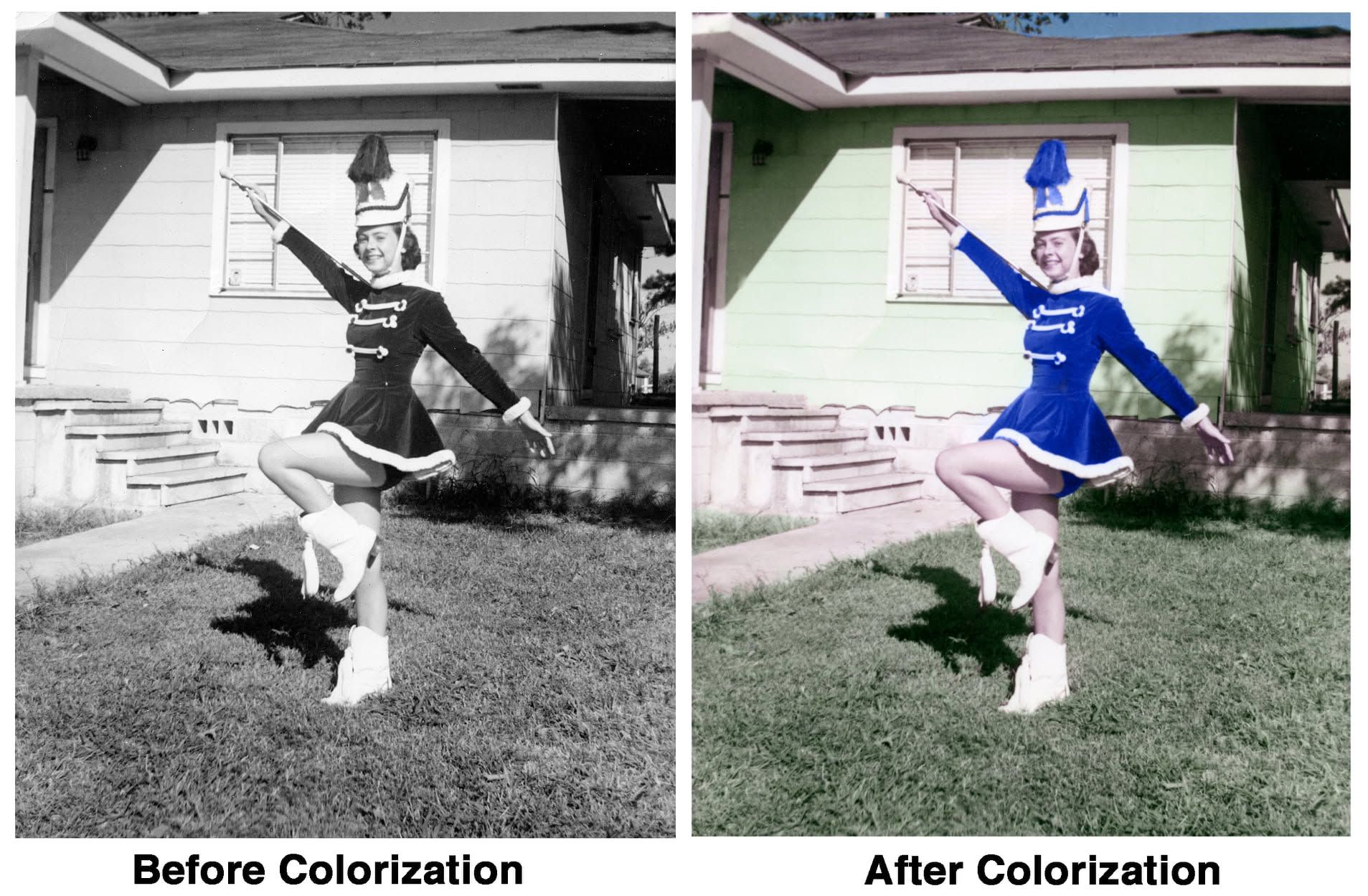
Photo colorization is different from both standard restoration and basic retouching.
When a black-and-white photograph is colorized, colors are intentionally added to create a new interpretation of the image.
Skin tones, clothing, backgrounds, furniture, landscapes, and other elements may require individual artistic decisions.
The goal is to produce a convincing color version without pretending that the new colors were captured in the original photograph.
Feldman’s Photography combines technical photographic expertise with an artistic approach to restoration. Melanie Feldman's background as a painter and photographic artist can be particularly valuable when projects require careful attention to color and visual detail.
Learn more at [Melanie Feldman – https://www.feldmansphotography.com/melanie-feldman].
Why Professional Restoration Matters for Irreplaceable Photos
Editing a disposable digital picture and restoring your family's only surviving photograph of a grandparent are very different situations.
An irreplaceable photograph deserves careful handling and realistic expectations.
Professional restoration is particularly valuable when:
- You only have one original.
- The photograph is historically important to your family.
- Damage crosses important facial features.
- The image is severely faded.
- Parts of the photograph are missing.
- You want to make an enlargement.
- You plan to give restored copies to relatives.
- You want to create a digital family archive.
Experience matters because restoration requires judgment.
Not every mark should necessarily be removed. Not every faded photograph should become intensely colorful. And not every old image should be processed until it looks like a modern photograph.
A successful restoration should improve the image without erasing its identity.
Can You Enlarge a Photo After It Has Been Restored?
In many cases, yes.
Restoration and enlargement can work particularly well together because damage can be addressed before a larger version of the image is produced.
Enlarging an old photograph without first addressing scratches, cracks, dust, or other damage may make those imperfections more noticeable.
Creating a high-quality digital version first provides an opportunity to restore the image and prepare it appropriately for reproduction.
Feldman’s Photography can enlarge photographs in addition to scanning, restoring, and digitizing them.
If you have a small family photograph you would like to display more prominently, ask about restoration and enlargement options together.
How Does Professional Photo Restoration Work?
Although every project is different, the process generally follows several important stages.
Step 1: Evaluate the Original
The photograph is reviewed to identify fading, tears, scratches, stains, missing portions, discoloration, and other concerns.
Step 2: Digitize the Photograph
A high-resolution digital version is created. This becomes the working image for restoration.
Step 3: Repair Damage
Scratches, cracks, tears, stains, and other visible problems can be carefully addressed.
Step 4: Correct Tone and Color
Brightness, contrast, color balance, and fading can be adjusted as needed.
Step 5: Perform Additional Retouching if Requested
If the customer wants aesthetic changes beyond restoration, those adjustments can be discussed separately.
Step 6: Prepare the Finished Image
The completed photograph can be saved digitally and prepared for appropriate reproduction or enlargement.
For examples of completed work, visit [Photos Restored – https://www.feldmansphotography.com/photos-restored].
Why Choose Feldman’s Photography for Photo Restoration in Tampa Bay?
When searching for the "best photo restoration near me," price shouldn't be the only consideration.
You're trusting someone with a piece of your family's history.
Feldman’s Photography has specialized in copying and restoring photographs since 1982. The company has worked on thousands of restoration projects and serves families throughout Tampa Bay and beyond.
Customers in Brandon, Tampa, St. Petersburg, Clearwater, Sarasota, and surrounding Florida communities can turn to Feldman’s Photography for services including:
- Professional photo restoration
- Photo scanning
- Photo digitization
- Slide digitization
- Negative digitization
- Color correction
- Photo colorization
- Photo enlargement
This combination is particularly useful when an old photograph needs more than one service.
Rather than simply editing the image, the objective is to create a high-quality version that helps preserve the photograph's story.
Frequently Asked Questions
Is photo restoration the same as Photoshop retouching?
No. Although similar digital tools may sometimes be involved, the goals are different. Photo restoration focuses on repairing damage and deterioration in an old photograph. Retouching generally focuses on improving or changing the appearance of an image.
Can a badly damaged photo be restored?
Many badly damaged photographs can be significantly improved, including images with fading, tears, scratches, stains, and certain missing sections. However, results depend on the amount of usable information remaining in the original image.
Should I restore or just scan my old photos?
If your photographs are in good condition, professional scanning may be enough for preservation. If they have fading, cracks, scratches, stains, discoloration, or other damage, scanning followed by restoration may provide a better result.
Can I keep the original photo unchanged?
Yes. Digital restoration allows work to be performed on a digital copy, leaving the original photograph intact. This is particularly valuable for sentimental or historically important photographs.
Where can I get old photos restored in Tampa Bay?
Feldman’s Photography specializes in professional photo restoration and digitization for customers throughout Tampa Bay, including Brandon, Tampa, St. Petersburg, Clearwater, Sarasota, and surrounding areas, as well as clients outside Florida.
Preserve the Photograph—and the Story Behind It
The difference between photo restoration and photo retouching comes down to purpose. Restoration repairs damage and deterioration; retouching improves or changes visual details. For old family photographs, professional restoration is often the right starting point because preserving the original memory matters as much as improving the picture.
If you have a faded wedding photograph, torn family portrait, scratched military photo, damaged childhood picture, or another image you're unsure can be saved, have it evaluated before assuming it's beyond repair.
Feldman’s Photography has specialized in restoring and copying photographs since 1982.
Call Feldman’s Photography at (813) 454-9495 to discuss your project, or use the [Info Request Form – https://www.feldmansphotography.com/info-request-form] to tell us about the photograph you'd like restored.
Serving Brandon, Tampa, St. Petersburg, Clearwater, Sarasota, the greater Tampa Bay area, and customers nationwide.
Related Services
From Our Blog
Contact Feldman's Photography Today
Your photographs and documents deserve professional care and preservation. Whether you need photo restoration, photo colorization, document preservation, photograph preserving services, or photo digitizing solutions, Feldman's Photography is ready to help.
Call today or submit our Info Request Form to discuss your project with an experienced restoration specialist.
Preserve your memories. Restore your history. Protect your legacy with Feldman's Photography.